The next great fintechs won’t run on banking rails
Stablecoins and self-custody are a transformational moment for the next generation of fintechs. Together they unlock global reach and the ability to ship a broad catalogue of financial products at speed.
Stablecoins and self-custody are a transformational moment for the next generation of fintechs. Together they unlock global reach and the ability to ship a broad catalogue of financial products at speed.
Traditional fintech has been hamstrung by one core limitation. Banking has always been welded to a rigid custody model that requires expensive licences and regulatory approval in every new geography. Self-custody and stablecoins break that mold. Distributing banking products becomes analogous to distributing technology. But the world doesn’t run on stablecoins. It runs on fiat, and therefore the licensing and regulatory burden moves to the edges.
Rhinestone is building the stablecoin operating system that makes distributing banking products universally accessible and instantly global.
There are three core problems we’re solving:
Existing wallet infrastructure does not meet global regulatory standards for self-custody. Each jurisdiction runs an independent set of tests. For a wallet to be self-custodial, it needs to meet the highest global bar.
Banking is a fragmented industry, making local stablecoin to fiat interoperability an endless list of integration complexity. This is a region-to-region business development challenge, not an engineering challenge.
Developing financial products onchain is still fraught with complexity. Builders are tired of stitching together 4-6 crypto service providers, rerunning the same internal infra buildout, before innovating on the actual product.
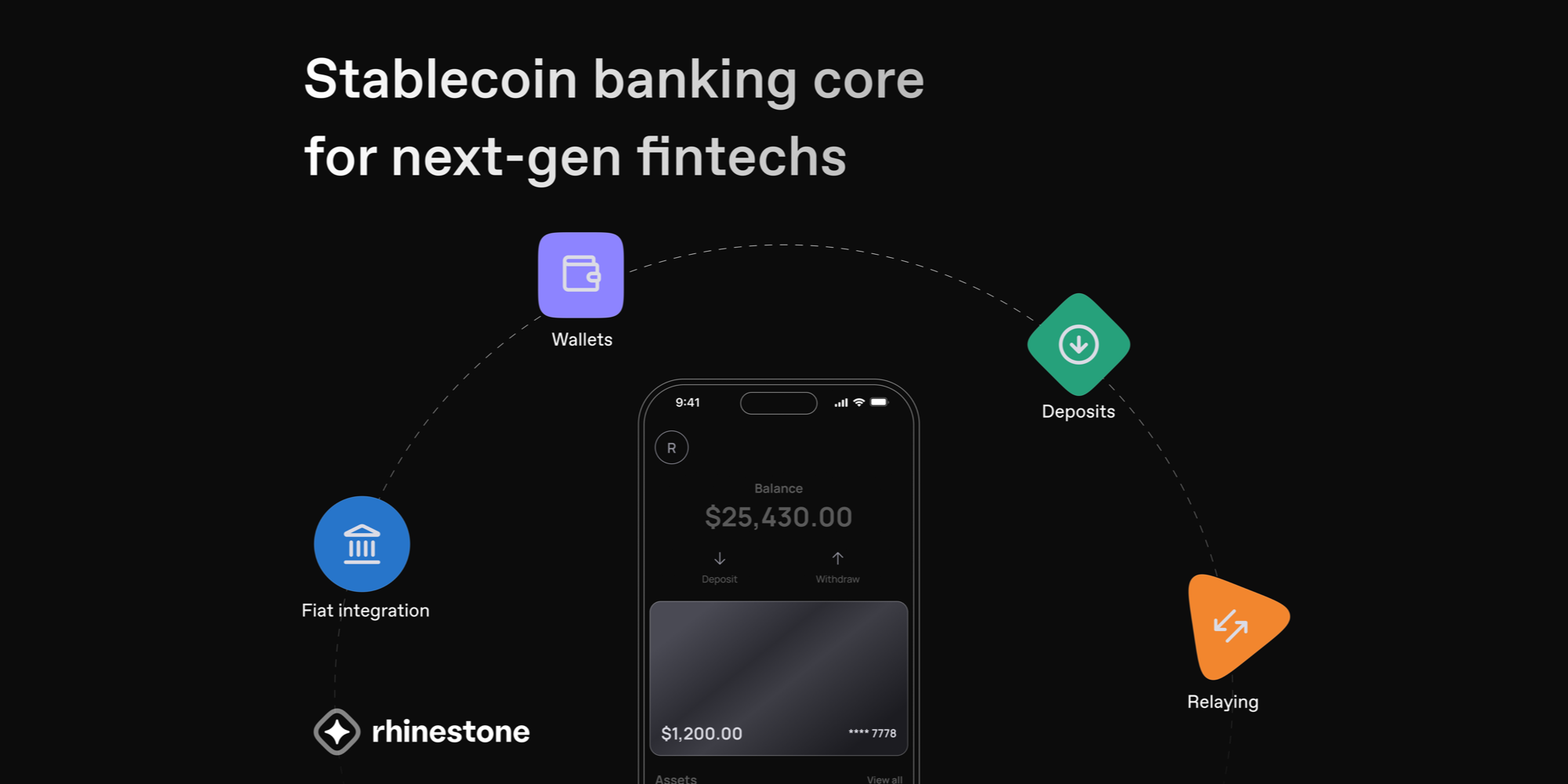
Rhinestone is offering four pillars to solve these problems:
Wallets – powered by passkeys and smart accounts.
Relaying – for gas abstraction, multichain, and swap routing.
Deposits – a hosted flow for ramps, crypto funding and withdrawals.
Fiat integrations – for global payin, payout and spend.
Self-custody is a commercial instrument, not an ideology
Traditionally banking equals custody which equals licensing, regulations and intermediaries. Not your keys, not your crypto is an ideology, but self-custody is a commercial tactic. When the application is removed from the chain of custody, with no control over the flow of money, there is no licensing requirement and no compliance overhead attached to each new product launch.
Under a custodial model every new onchain product comes with an expensive (time and money) admissions process. In the EU each token and protocol integration into a custodial application requires an admission to trading. This means submission of regulatory whitepapers, screening, carbon emissions footprint assessments, sanction screening of founders, etc.
Under self-custody the user holds the asset, the app is a technology provider. The consequence is cycle time and reach advantage. A self-custodial product ships products a custodial one cannot, at a speed and global reach that a custodial one cannot match.
In practice that means shipping banking products without becoming a regulated entity. No custody licence, no money-transmitter licence, no CASP authorisation.
Regulators are getting serious about self-custody
Self-custody is not clear-cut. Embedded wallets on the market today are not meeting the bar global regulators are setting. What passes as self-custody in the US may not pass in the EU. A backend that can sign without the user, reconstitute the key or censor recovery jeopardizes self-custody. Within regulated fintechs, this equates to long compliance reviews and red tape that become significant blockers in a product roadmap.
Rhinestone is innovating at the key layer to solve this exact problem and offer a key management layer that is unquestionably self-custodial. It all starts with client-side key generation and smart accounts. More on this to come in future posts.
The world doesn’t run on stablecoins (yet)
The world still runs on fiat. Every app is a fiat in, stablecoin, fiat out sandwich, and the sandwich reintroduces every regional barrier self-custody works to remove. Local ramps, sponsor bank relationships per currency, KYC, and more. These are business development challenges, not engineering challenges.
With Rhinestone, virtual accounts and card issuing run through licensed partners. KYC and AML sit with the licence holder, with one shared verification across them, so the app integrates once, not once per region.
Product builders buy infrastructure and innovate
Today, every neobank builds the infrastructure before building the product. Stitching together wallets, gas abstraction, swap routing, multichain, onramps, virtual accounts, cards, yield. Four to six vendors minimum, each with its own contract, SLA, integration and surrounding technology to get it all harmoniously operating. Eighteen months of plumbing before a builder can start innovating and differentiating. And when a flow breaks halfway across vendor boundaries, no single vendor owns the outcome – they all point at one another.
In traditional finance, fintechs rent a charter, buy a bank core, and launch. With stablecoins, blockchains and self-custody replace the charter, and Rhinestone is building the “bank core” to unlock these new primitives for the next wave of fintech builders.
Rhinestone is building the stablecoin banking core
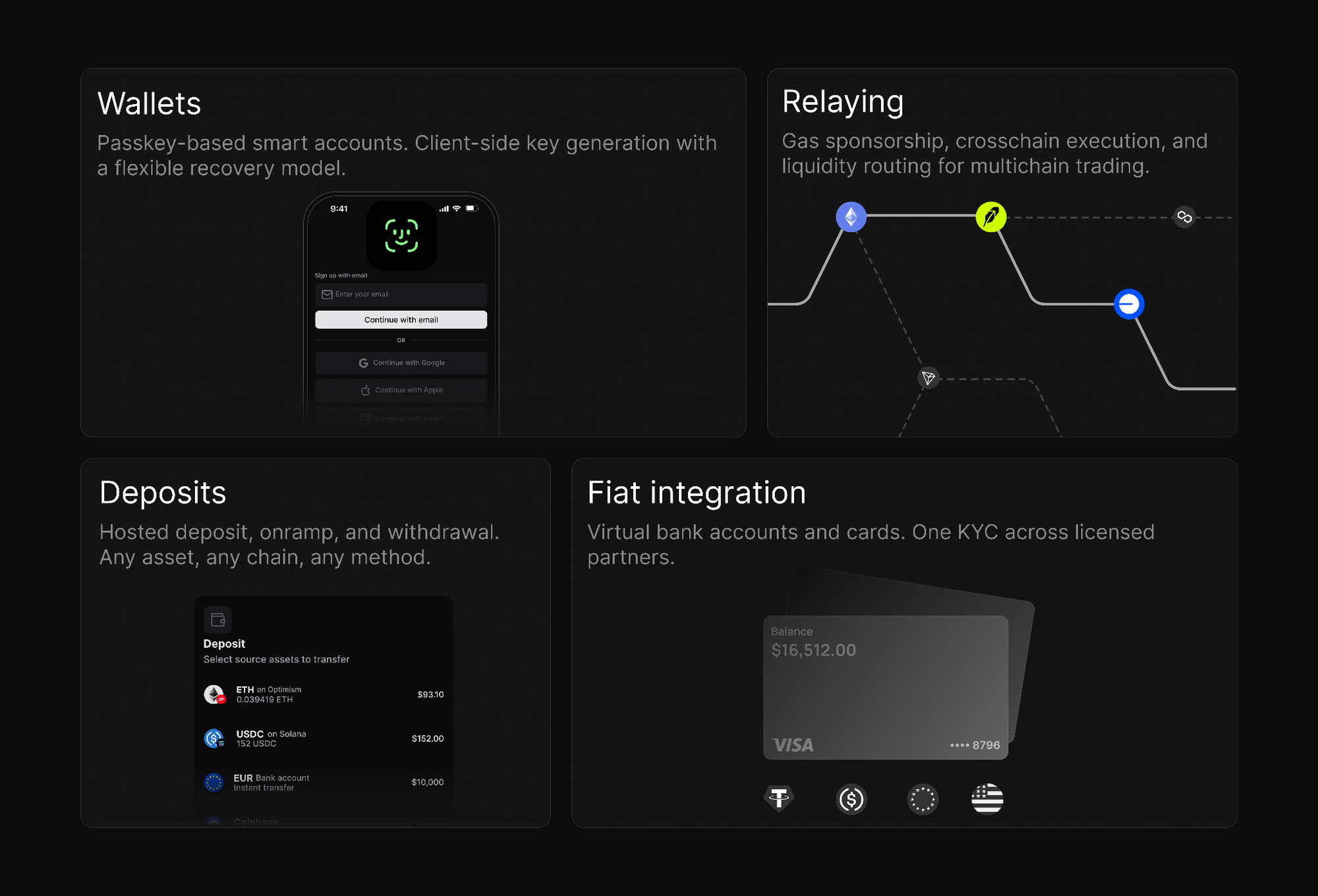
Four products form the foundation of the stablecoin bank core, all welded together at the account layer. One integration. One contract. One SLA.
Wallets: An embedded passkey wallet with client-side key generation. No key server between the app and the user, no vendor that can move funds or censor.
Deposits: One hosted flow that turns signups into funded customers. Wallet, exchange, card, Apple Pay or bank transfer, settled as one token on one chain.
Relaying: Gas sponsorship, crosschain, swaps and trading. SLA-backed settlement that reroutes and self-heals without the user in the loop.
Fiat integrations: Virtual bank accounts and stablecoin cards per wallet, in every currency you need. One KYC shared across licensed partners closes the fiat gap.
Serving the financial apps of the future
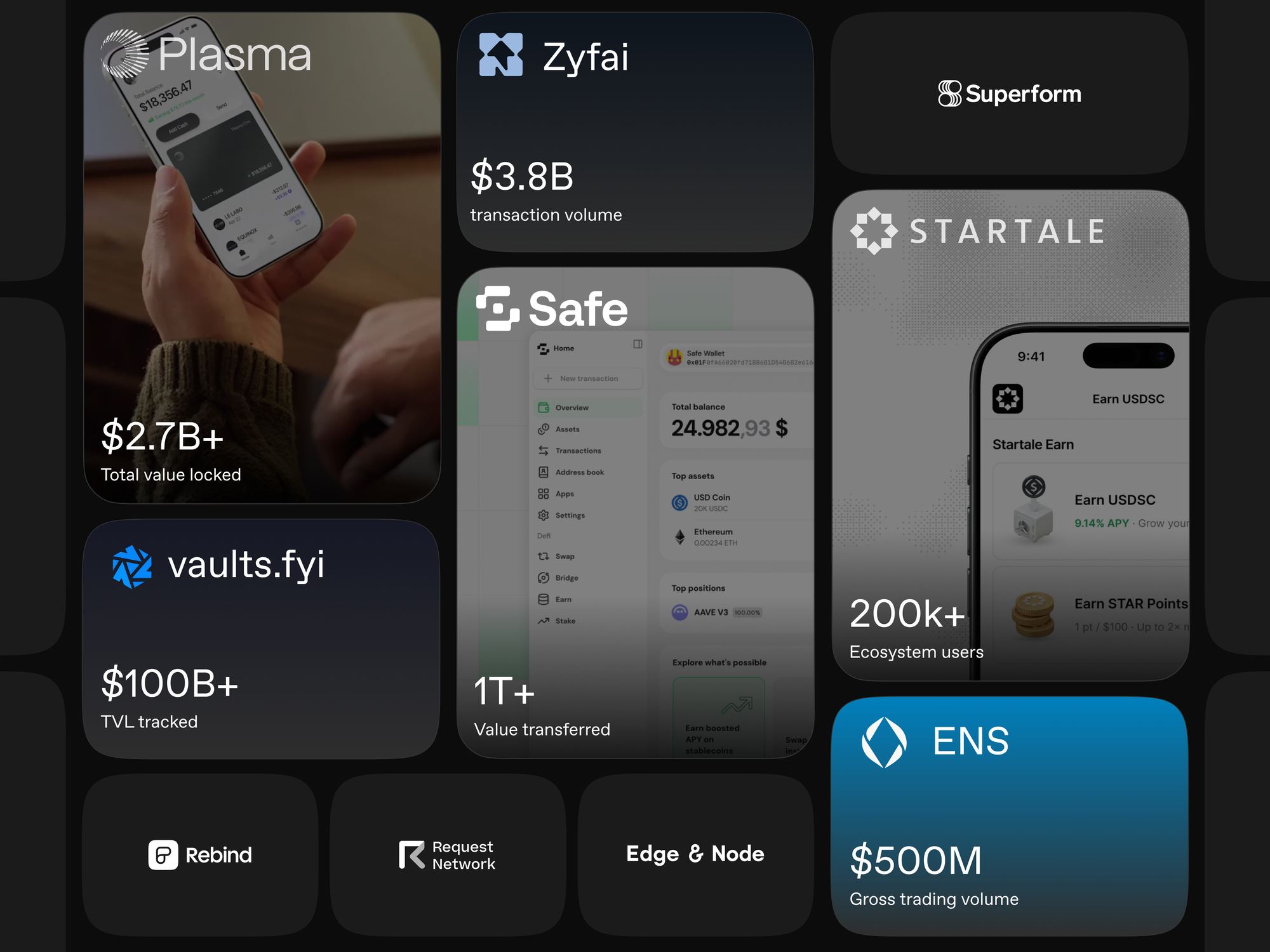
Rhinestone is already supporting teams building on the frontier of fintech, including Plasma One, Safe, Startale Group and many more.
Fintech was embedded payments. It’s now embedded banking.
Fintech made payments embeddable. Self-custody and stablecoins embed banking, without the need for a charter or a licence stack per region. Neobanks are the first wave of builders taking advantage of this technology. Ultimately, any application that holds balance or moves value is next. Marketplaces, payroll, creator platforms, remittance, gig economy platforms, agents.
Get in contact
If you’re building on the frontier of fintech, going global and shipping products at speed, we are here to support. Get in contact to learn more.